President Trump delivers a stark warning to key allies UK and Canada: deepening business ties with China is “very dangerous,” risking American security interests.
Story Snapshot
- Trump cautions UK Prime Minister Keir Starmer after his Beijing meeting with Xi Jinping, calling closer China ties perilous for both nations.
- Canada faces even greater risk, per Trump, following PM Mark Carney’s recent China engagements and prior tariff threats.
- Starmer’s visit yields UK wins like whisky tariff cuts and visa-free travel, but ignores U.S. concerns over human rights and global stability.
- Trump’s hardline stance protects American workers from China’s predatory trade practices and bolsters alliances against Beijing’s expansionism.
Trump’s Direct Warning to Allies
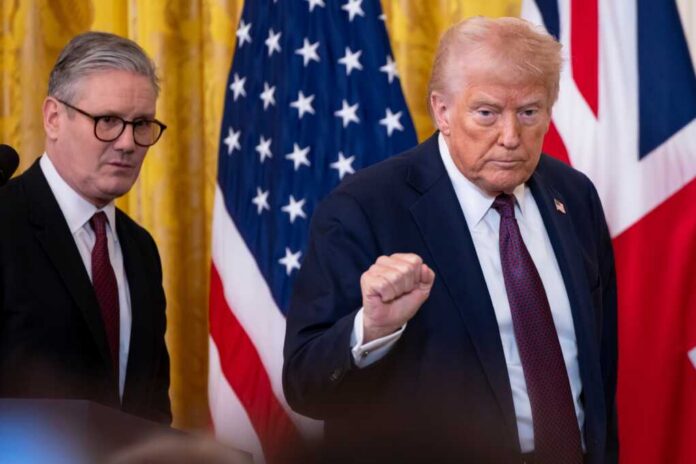
On January 29, 2026, President Donald Trump addressed reporters en route to the “Melania” film premiere in Washington. He warned the United Kingdom that pursuing deeper business with China would prove “very dangerous.” Trump escalated for Canada, deeming it “even more dangerous.” This response followed UK Prime Minister Keir Starmer’s 80-minute Beijing summit with Chinese President Xi Jinping. Starmer hailed the talks as “very productive,” announcing advances on whisky tariffs, visa-free Briton travel, migration cooperation, and measures against Channel smuggling boats. Trump’s intervention underscores his commitment to shielding allies from China’s economic traps, prioritizing U.S.-led security over short-term deals that undermine Western unity.
Watch:
https://www.youtube.com/shorts/CuMeKztwZoM
Starmer’s Beijing Reset Amid Tensions
Keir Starmer’s January 29 meeting marked the first UK prime ministerial visit to China in eight years, signaling a “reset” after frictions over Hong Kong, human rights, and trade since 2018. Discussions covered climate, stability, visas, and Iran nuclear issues. Xi emphasized dialogue to avoid a global “jungle” of lawlessness, while Starmer pursued pragmatic gains for British exporters. This thaw aligns with Beijing’s outreach to U.S. allies, the fourth such leader visit that month. Conservatives view such overtures warily, as they risk empowering China’s authoritarian regime at the expense of democratic principles and fair trade.
Canada’s Vulnerability and Precedents
Canadian Prime Minister Mark Carney recently visited China, striking economic deals that drew Trump’s prior rebuke: “China will eat Canada alive.” Trump has threatened tariffs in response, echoing his protectionist playbook. A November 2025 U.S.-China pact eased some tariffs on agriculture, semiconductors, and shipping, yet Trump maintains pressure via export controls and fentanyl curbs. These dynamics highlight power imbalances, where smaller economies face China’s incentives against U.S. military and trade pacts. Trump’s personal rapport with Xi—”a friend of mine”—informs his stark counsel, blending diplomacy with deterrence.
Global pressures like Arctic defense and Chagos Islands sovereignty amplify risks, as UK-Canada tilt toward Beijing could complicate U.S. bases and alliances. Trump’s planned April 2026 China trip reinforces his strategy of engagement on American terms.
Implications for Alliances and Security
Short-term, Trump’s warnings signal potential U.S. tariffs on UK and Canadian goods, straining transatlantic ties while protecting American industries. Long-term, they counter China’s proxy expansion through allies, preserving NATO cohesion and countering threats in fentanyl flows and semiconductors. Expert Gordon Chang praises Trump’s “hard power” as vital against appeasement. Affected sectors include UK whisky exporters and Canadian firms weighing China access versus U.S. markets. Political fallout tests alliance loyalty, with social gains like migration curbs offset by persistent human rights concerns. As of January 30, no official replies from London, Ottawa, or Beijing, leaving tensions unresolved.
Sources:
Trump says ‘very dangerous’ for UK to get into business with China
Trump warns UK it’s ‘very dangerous’ do business with China after Starmer’s Beijing meeting